#include <extended_kalman_filter.h>
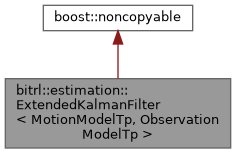
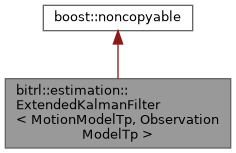
Public Types | |
| typedef MotionModelTp | motion_model_type |
| typedef ObservationModelTp | observation_model_type |
| typedef motion_model_type::input_type | motion_model_input_type |
| typedef motion_model_type::matrix_type | matrix_type |
| typedef motion_model_type::state_type | state_type |
| typedef observation_model_type::input_type | observation_model_input_type |
Public Member Functions | |
| ExtendedKalmanFilter () | |
| Constructor. | |
| ExtendedKalmanFilter (motion_model_type &motion_model, const observation_model_type &observation_model) | |
| Constructor. Initialize with a writable reference of the motion model and a read only reference of the observation model. | |
| ~ExtendedKalmanFilter () | |
| Destructor. | |
| void | estimate (const std::tuple< motion_model_input_type, observation_model_input_type > &input) |
| Estimate the state. This function simply wraps the predict and update steps described by the functions below. | |
| void | predict (const motion_model_input_type &input) |
| Predicts the state vector x and the process covariance matrix P using the given input control u accroding to the following equations. | |
| void | update (const observation_model_input_type &z) |
| Updates the gain matrix K, the state vector x and covariance matrix P using the given measurement z_k according to the following equations. | |
| void | set_motion_model (motion_model_type &motion_model) |
| Set the motion model. | |
| void | set_observation_model (const observation_model_type &observation_model) |
| Set the observation model. | |
| void | set_matrix (const std::string &name, const matrix_type &mat) |
| Set the matrix used by the filter. | |
| bool | has_matrix (const std::string &name) const |
| Returns true if the matrix with the given name exists. | |
| const state_type & | get_state () const |
| Returns the state. | |
| state_type & | get_state () |
| Returns the state. | |
| real_t | get (const std::string &name) const |
| Returns the state property with the given name. | |
| const DynMat< real_t > & | operator[] (const std::string &name) const |
| Returns the name-th matrix. | |
| DynMat< real_t > & | operator[] (const std::string &name) |
| Returns the name-th matrix. | |
| ExtendedKalmanFilter & | with_matrix (const std::string &name, const matrix_type &mat) |
| Set the matrix and return *this. | |
Protected Attributes | |
| motion_model_type * | motion_model_ptr_ |
| pointer to the function that computes f | |
| const observation_model_type * | observation_model_ptr_ |
| pointer to the function that computes h | |
| std::map< std::string, matrix_type > | matrices_ |
| Matrices used by the filter internally. | |
Detailed Description
class bitrl::estimation::ExtendedKalmanFilter< MotionModelTp, ObservationModelTp >
Implements the Extended Kalman filter algorithm. The class expects a number of inputs in order to be useful. Concretely the application must specity
MotionModelTp a motion model ObservationModelTp observation model
The MotionModelTp should expose the following functions
evaluate(MotionModelTp input)-->State& get_matrix(const std::string)—>DynMat
In particular, the class expects the L, F matrices to be supplied via the get_matix function of the motion model.
Similarly, the ObservationModelTp should expose the following functions
evaluate(ObservationModelTp& input)—>DynVec get_matrix(const std::string)—>DynMat
In particular, the class expects the M, H matrices to be supplied via the get_matix function of the observation model.
Finally, the application should supply the P, Q, R matrices associated with the process
Member Typedef Documentation
◆ matrix_type
| typedef motion_model_type::matrix_type bitrl::estimation::ExtendedKalmanFilter< MotionModelTp, ObservationModelTp >::matrix_type |
◆ motion_model_input_type
| typedef motion_model_type::input_type bitrl::estimation::ExtendedKalmanFilter< MotionModelTp, ObservationModelTp >::motion_model_input_type |
◆ motion_model_type
| typedef MotionModelTp bitrl::estimation::ExtendedKalmanFilter< MotionModelTp, ObservationModelTp >::motion_model_type |
◆ observation_model_input_type
| typedef observation_model_type::input_type bitrl::estimation::ExtendedKalmanFilter< MotionModelTp, ObservationModelTp >::observation_model_input_type |
◆ observation_model_type
| typedef ObservationModelTp bitrl::estimation::ExtendedKalmanFilter< MotionModelTp, ObservationModelTp >::observation_model_type |
◆ state_type
| typedef motion_model_type::state_type bitrl::estimation::ExtendedKalmanFilter< MotionModelTp, ObservationModelTp >::state_type |
Constructor & Destructor Documentation
◆ ExtendedKalmanFilter() [1/2]
| bitrl::estimation::ExtendedKalmanFilter< MotionModelTp, ObservationModelTp >::ExtendedKalmanFilter | ( | ) |
Constructor.
◆ ExtendedKalmanFilter() [2/2]
| bitrl::estimation::ExtendedKalmanFilter< MotionModelTp, ObservationModelTp >::ExtendedKalmanFilter | ( | motion_model_type & | motion_model, |
| const observation_model_type & | observation_model | ||
| ) |
Constructor. Initialize with a writable reference of the motion model and a read only reference of the observation model.
◆ ~ExtendedKalmanFilter()
| bitrl::estimation::ExtendedKalmanFilter< MotionModelTp, ObservationModelTp >::~ExtendedKalmanFilter | ( | ) |
Destructor.
Member Function Documentation
◆ estimate()
| void bitrl::estimation::ExtendedKalmanFilter< MotionModelTp, ObservationModelTp >::estimate | ( | const std::tuple< motion_model_input_type, observation_model_input_type > & | input | ) |
Estimate the state. This function simply wraps the predict and update steps described by the functions below.
◆ get()
|
inline |
Returns the state property with the given name.
◆ get_state() [1/2]
|
inline |
Returns the state.
◆ get_state() [2/2]
|
inline |
Returns the state.
◆ has_matrix()
| bool bitrl::estimation::ExtendedKalmanFilter< MotionModelTp, ObservationModelTp >::has_matrix | ( | const std::string & | name | ) | const |
Returns true if the matrix with the given name exists.
◆ operator[]() [1/2]
| DynMat< real_t > & bitrl::estimation::ExtendedKalmanFilter< MotionModelTp, ObservationModelTp >::operator[] | ( | const std::string & | name | ) |
Returns the name-th matrix.
◆ operator[]() [2/2]
| const DynMat< real_t > & bitrl::estimation::ExtendedKalmanFilter< MotionModelTp, ObservationModelTp >::operator[] | ( | const std::string & | name | ) | const |
Returns the name-th matrix.
◆ predict()
| void bitrl::estimation::ExtendedKalmanFilter< MotionModelTp, ObservationModelTp >::predict | ( | const motion_model_input_type & | input | ) |
Predicts the state vector x and the process covariance matrix P using the given input control u accroding to the following equations.
\hat{x}_{k = f(x_{k-1}, u_{k}, w_k) \hat{P}_{k} = F_{k-1} * P_{k-1} * F_{k-1}^T + L_{k-1} * Q_{k-1} * L_{k-1}^T
where x_{k-1} is the state at the previous step, u_{k} is the control signal and w_k is the error associated with the control signal. In input argument passed to the function is meant to model in a tuple all the arguments needed. F, L are Jacobian matrices and Q is the covariance matrix associate with the control signal
make a state prediction using the motion model
◆ set_matrix()
| void bitrl::estimation::ExtendedKalmanFilter< MotionModelTp, ObservationModelTp >::set_matrix | ( | const std::string & | name, |
| const matrix_type & | mat | ||
| ) |
Set the matrix used by the filter.
◆ set_motion_model()
|
inline |
Set the motion model.
◆ set_observation_model()
|
inline |
Set the observation model.
◆ update()
| void bitrl::estimation::ExtendedKalmanFilter< MotionModelTp, ObservationModelTp >::update | ( | const observation_model_input_type & | z | ) |
Updates the gain matrix K, the state vector x and covariance matrix P using the given measurement z_k according to the following equations.
K_k = \hat{P}_{k} * H_{k}^T * (H_k * \hat{P}_{k} * H_{k}^T + M_k * R_k * M_k^T)^{-1} x_k = \hat{x}_{k} + K_k * (z_k - h( \hat{x}_{k}, 0)) P_k = (I - K_k * H_k) * \hat{P}_{k}
update the covariance matrix
◆ with_matrix()
| ExtendedKalmanFilter< MotionModelTp, ObservationModelTp > & bitrl::estimation::ExtendedKalmanFilter< MotionModelTp, ObservationModelTp >::with_matrix | ( | const std::string & | name, |
| const matrix_type & | mat | ||
| ) |
Set the matrix and return *this.
Member Data Documentation
◆ matrices_
|
protected |
Matrices used by the filter internally.
◆ motion_model_ptr_
|
protected |
pointer to the function that computes f
◆ observation_model_ptr_
|
protected |
pointer to the function that computes h
The documentation for this class was generated from the following file:
- libs/bitrl/src/bitrl/estimation/extended_kalman_filter.h