Loading...
Searching...
No Matches
vector_math.h File Reference
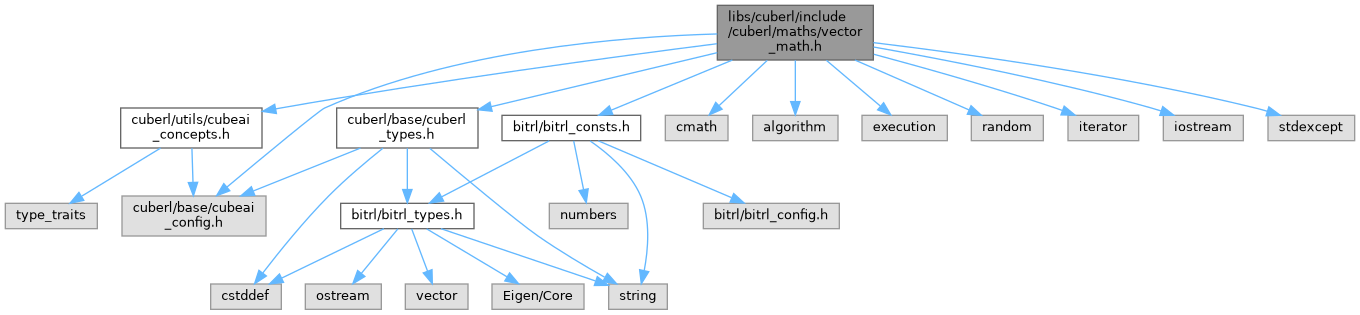
#include "cuberl/base/cuberl_config.h"#include "cuberl/base/cuberl_types.h"#include "cuberl/utils/cuberl_concepts.h"#include "bitrl/bitrl_consts.h"#include <cmath>#include <algorithm>#include <execution>#include <random>#include <iterator>#include <iostream>#include <stdexcept>
Include dependency graph for vector_math.h:
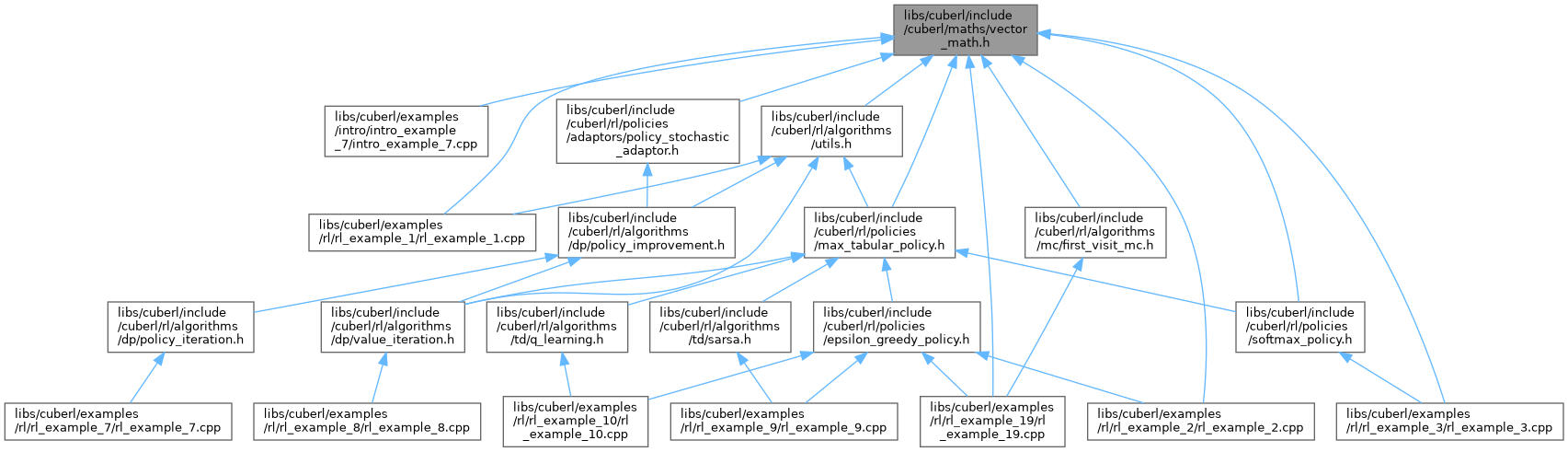
This graph shows which files directly or indirectly include this file:
Go to the source code of this file.
Classes | |
| struct | cuberl::maths::detail_::randomize_handler< real_t > |
| struct | cuberl::maths::detail_::randomize_handler< float_t > |
Namespaces | |
| namespace | cuberl |
| Various utilities used when working with RL problems. | |
| namespace | cuberl::maths |
| namespace | cuberl::maths::detail_ |
Functions | |
| template<utils::concepts::float_or_integral_vector VectorType> | |
| VectorType | cuberl::maths::element_product (const VectorType &v1, const VectorType &v2) |
| template<typename IteratorType > | |
| std::iterator_traits< IteratorType >::value_type | cuberl::maths::sum (IteratorType begin, IteratorType end, bool parallel=true) |
| template<typename VectorType > | |
| VectorType::value_type | cuberl::maths::sum (const VectorType &vec, bool parallel=true) |
| template<typename IteratorType > | |
| real_t | cuberl::maths::mean (IteratorType begin, IteratorType end, bool parallel=true) |
| mean Compute the mean value of the values in the provided iterator range | |
| template<utils::concepts::float_or_integral_vector VectorType> | |
| real_t | cuberl::maths::mean (const VectorType &vector, bool parallel=true) |
| mean Computes the mean value of the vector. If parallel=true it uses std::reduce | |
| template<typename T > | |
| real_t | cuberl::maths::mean (const DynVec< T > &vector, bool parallel=true) |
| mean computes the mean value of the given DynVec | |
| template<typename IteratorType > | |
| std::iterator_traits< IteratorType >::value_type | cuberl::maths::variance (IteratorType begin, IteratorType end, bool parallel=true) |
| real_t | cuberl::maths::variance (const std::vector< real_t > &vals, bool parallel=true) |
| Compute the variance of the given std::vector of real values. | |
| std::vector< real_t > | cuberl::maths::standardize (const std::vector< real_t > &vals, real_t tol=bitrl::consts::TOLERANCE) |
| Standardize the given vector. | |
| template<utils::concepts::float_vector Vec2> | |
| uint_t | cuberl::maths::choice (const Vec2 &probs, uint_t seed=42) |
| choice. Implements similar functionality to numpy.choice function | |
| template<utils::concepts::integral_vector Vec1, utils::concepts::float_vector Vec2> | |
| uint_t | cuberl::maths::choice (const Vec1 &choices, const Vec2 &probs, uint_t seed=42) |
| choice. Implements similar functionality to numpy.choice function | |
| template<utils::concepts::float_vector Vec> | |
| Vec::value_type | cuberl::maths::choose_value (const Vec &vals, uint_t seed=42) |
| template<utils::concepts::float_or_integral_vector Vec> | |
| void | cuberl::maths::randomize_vec (Vec &v, const Vec &walk_set, uint_t seed=42) |
| Given a vector of intergal or floating point values and a set of values to choose from, randomize the entries ofv. | |
| template<typename T > | |
| std::vector< T > & | cuberl::maths::randomize (std::vector< T > &vec, T a, T b, uint_t seed=42) |
| Fill in the given vector with random values. | |
| template<utils::concepts::float_or_integral_vector Vec> | |
| Vec & | cuberl::maths::divide (Vec &v1, typename Vec::value_type val) |
| template<utils::concepts::float_or_integral_vector Vec> | |
| Vec & | cuberl::maths::add (Vec &v1, const Vec &v2) |
| template<utils::concepts::float_or_integral_vector VectorType> | |
| VectorType | cuberl::maths::exponentiate (const VectorType &vec) |
| template<utils::concepts::float_or_integral_vector VectorType> | |
| VectorType | cuberl::maths::exponentiate (const VectorType &vec, typename VectorType::value_type v) |
| template<typename T > | |
| std::vector< T > | cuberl::maths::softmax_vec (const std::vector< T > &vec, real_t tau=1.0) |
| applies softmax operation to the elements of the vector and returns a vector with the result | |
| template<typename T > | |
| DynVec< T > | cuberl::maths::softmax_vec (const DynVec< T > &vec, real_t tau=1.0) |
| applies softmax operation to the elements of the vector and returns a vector with the result | |
| template<typename IteratorType > | |
| DynVec< typename IteratorType::value_type > | cuberl::maths::softmax_vec (IteratorType begin, IteratorType end, real_t tau=1.0) |
| applies softmax operation to the elements of the vector and returns a vector with the result | |
| template<typename VectorType > | |
| uint_t | cuberl::maths::arg_max (const VectorType &vec) |
| Returns the index of the element that has the maximum value in the array. Implementation taken from http://www.jclay.host/dev-journal/simple_cpp_argmax_argmin.html. | |
| template<typename VectorType > | |
| uint_t | cuberl::maths::arg_min (const VectorType &vec) |
| Returns the index of the element that has the minimum value in the array. Implementation taken from http://www.jclay.host/dev-journal/simple_cpp_argmax_argmin.html. | |
| template<typename T > | |
| std::vector< uint_t > | cuberl::maths::max_indices (const DynVec< T > &vec) |
| template<typename VecTp > | |
| std::vector< uint_t > | cuberl::maths::max_indices (const VecTp &vec) |
| Returns the indices of vec where the maximum value in vec occurs. | |
| template<typename T > | |
| std::vector< T > | cuberl::maths::extract_subvector (const std::vector< T > &vec, uint_t end, bool up_to=true) |
| template<typename SequenceTp > | |
| uint_t | cuberl::maths::bin_index (const typename SequenceTp::value_type &x, const SequenceTp &sequence) |
| bin_index. Compute sequnce[i - 1] <= x sequnce[i] and returns the index. Sequence should be sorted | |
| template<typename VectorType > | |
| VectorType | cuberl::maths::zero_center (const VectorType &vec, bool parallel=true) |
| zero_center. Subtracts the mean value of the given vector from every value of the vector | |
| template<typename VectorType > | |
| VectorType | cuberl::maths::normalize (const VectorType &vec, typename VectorType::value_type v) |
| Normalize the values of the given vector with the given value. Essentially this function divides the elements of the vector with the value provided. | |
| template<typename T > | |
| std::vector< T > | cuberl::maths::normalize_max (const std::vector< T > &vec) |
| template<typename T > | |
| std::vector< T > | cuberl::maths::normalize_min (const std::vector< T > &vec) |
| std::vector< real_t > | cuberl::maths::logspace (real_t start, real_t end, uint_t num, real_t base=10.0) |
| template<typename IteratorType > | |
| std::iterator_traits< IteratorType >::value_type | cuberl::maths::dot_product (IteratorType bv1, IteratorType ev1, IteratorType bv2, IteratorType ev2) |
| template<typename VectorType > | |
| real_t | cuberl::maths::dot_product (const VectorType &v1, const VectorType &v2, uint_t start_idx=0) |