bitrl & cuberl Documentation
Simulation engine for reinforcement learning agents
Loading...
Searching...
No Matches
CubeRL Example 14 Q-learning on CliffWorld

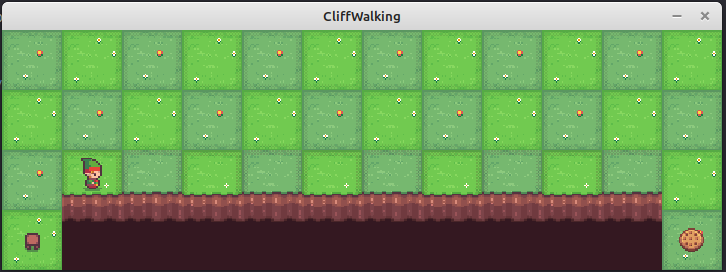
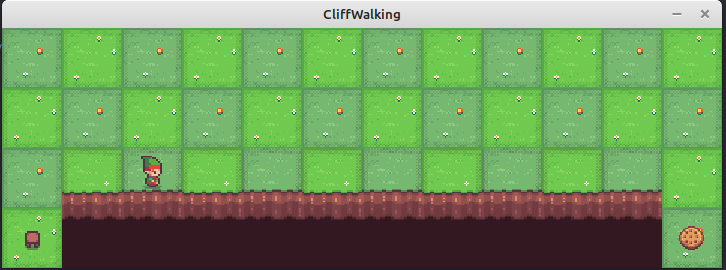
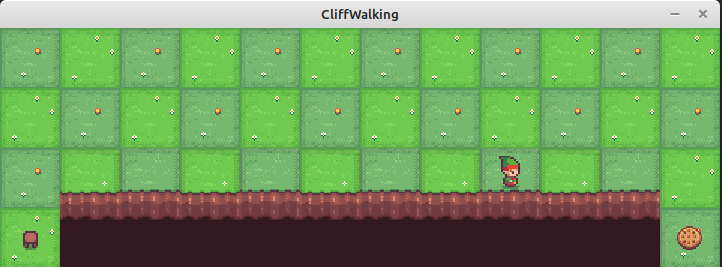
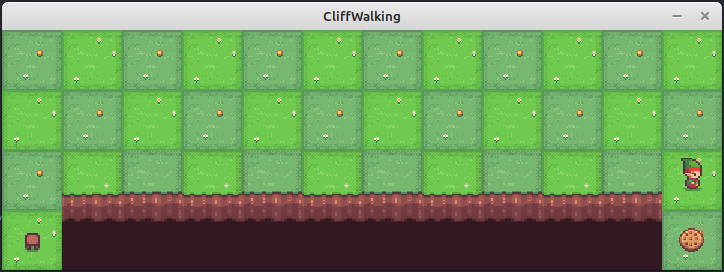
In this example, we will apply another temporal difference learning algorithm namely Q-learning on CliffWorld. This is a Gymnasium-based environment implemented in bitrl::envs::gymnasium::CliffWorld class. We used this environment in example CubeRL Example 13: SARSA on CliffWorld.

Q-learning, just like SARSA, is a model-free reinforcement learning algorithm that learns how good an action is in a given state, without needing a model of the environment. As the name suggests, the algorithms learns a state-action value function \(Q(s,\alpha)\). The algorithm is very similar to SARSA. Before we show the algorithmic steps, here is the update function used in Q-learning

$$ Q(s,\alpha) = Q(s,\alpha) + \eta \big[r_t + \gamma \max_{\alpha_{t+1}} Q(s_{t+1}, \alpha_{t+1}) - Q(s,\alpha)\big] $$

The algorithm just like SARSA looks into the future but always selects the action that provides the best $Q$. Contrast this with the update formula for SARSA:

$$ Q(s_t, \alpha_t) = Q(s_t, \alpha_t) + \eta \left[r_{t+1} + \gamma Q(s_{t+1}, \alpha_{t+1}) - Q(s_t, \alpha_t) \right] $$

So Q-learning instead of consulting \(\pi\) about \(\alpha_{t+1}\) it simply acts greedily and selects the action that provides the best state-action value function. This is called optimistic bootstrapping; assume the best possible action will be taken next, regardless of what we'll actually do. Here are the steps for Q-learning. These are very similar to SARSA:

Step 1

The first step is to initialize the table that represents $Q(s,\alpha)$ to arbitrary values; often this is just zero. This however, can also be values that encourage exploration.

Step 2

The algorithm begins by some be presented with a state. Q-learning needs to decide what to do whilst at this state. This is done using a policy $\pi$ which most often will be an \(\epsilon-\)greedy policy.

Step 3

The algorithm will execute the action that was selected from step 2. The environment will respond with a reward \(r_t\) and the new state \(s_{t+1}\). In order to apply the update formula we need to calculate what is the best \(Q\) at \(s_{t+1}\). The update rule, see above, is using the future \(maxQ(s_{t+1}, \alpha_{t+1})\) in order to update the current \(Q(s_{t}, \alpha_{t})\) Compared to SARSA, in Q-learning we don't necessarily choose \(\alpha_{t+1}\) when at \(s_{t+1}\) but instead ask the policy to provide the action to.

Step 4

After updating, we move to \(s_{t+1}\) and ask \(\pi\) to provide us with an action and we repeat step 3. If we've reached a terminal state (like the end of a game or a completed transaction), the episode ends and we start fresh. The environment has to inform the agent about whether it reached the end of the game or not. So when we take an action in the environment, we will usually receive not just a reward signal and the next state but also a flag indicating if the end of the game or simulation has been reached.

All in all, Q-learning learns the optimal policy. It is a fast and efficient algorithm that is ideal for batch learning. Q-learning, compared to SARSA, is more optimistic which can be dangerous in risky domains, and it suffers from maximization bias that can overestimate action values when estimates are noisy [2].

The Q-learning algorithm is implemented in the cuberl::rl::algos::td::QLearningSolver class
namespace rl_example_10{
const std::string SERVER_URL = "http://0.0.0.0:8001/api";
const std::string SOLUTION_FILE = "qlearning_cliff_walking_v1.csv";
const std::string REWARD_PER_ITR = "reward_per_itr.csv";
const std::string POLICY = "policy.csv";
}
int main(){
BOOST_LOG_TRIVIAL(info)<<"Starting agent training";
using namespace rl_example_10;
try{
RESTRLEnvClient server(SERVER_URL, true);
// create the environment
env_type env(server);
BOOST_LOG_TRIVIAL(info)<<"Creating environment...";
std::unordered_map<std::string, std::any> options;
std::unordered_map<std::string, std::any> reset_options;
env.make("v0", options, reset_options);
env.reset();
BOOST_LOG_TRIVIAL(info)<<"Done...";
BOOST_LOG_TRIVIAL(info)<<"Number of states="<<env.n_states();
BOOST_LOG_TRIVIAL(info)<<"Number of actions="<<env.n_actions();
// create an e-greedy policy. Use the number
// of actions as a seed. Use a constant epsilon
EpsilonGreedyPolicy policy(0.01, env.n_actions(),
EpsilonDecayOption::NONE);
QLearningConfig qlearn_config;
qlearn_config.gamma = 0.9;
qlearn_config.eta = 0.5;
qlearn_config.tolerance = 1.0e-8;
qlearn_config.max_num_iterations_per_episode = 1000;
qlearn_config.path = SOLUTION_FILE;
QLearningSolver<env_type, EpsilonGreedyPolicy> algorithm(qlearn_config, policy);
RLSerialTrainerConfig trainer_config = {10, 1000, 1.0e-8};
QLearningSolver<env_type, EpsilonGreedyPolicy>> trainer(trainer_config, algorithm);
auto info = trainer.train(env);
BOOST_LOG_TRIVIAL(info)<<info;
// save the reward the agent achieved per training epoch
auto reward = trainer.episodes_total_rewards();
auto iterations = trainer.n_itrs_per_episode();
bitrl::utils::io::CSVWriter csv_writer(REWARD_PER_ITR);
csv_writer.open();
csv_writer.write_column_names({"epoch", "reward"});
auto epoch = static_cast<uint_t>(0);
for(auto val: reward){
std::tuple<uint_t, real_t> row = {epoch++, val};
csv_writer.write_row(row);
}
csv_writer.close();
// build the policy
algorithm.build_policy().save(POLICY);
}
catch(std::exception& e){
std::cout<<e.what()<<std::endl;
}
catch(...){
std::cout<<"Unknown exception occured"<<std::endl;
}
return 0;
}
The CliffWorld class.
Definition cliff_world_env.h:59
Utility class to facilitate HTTP requests between the environments REST API and C++ drivers.
Definition rest_rl_env_client.h:29
The CSVWriter class. Handles writing into CSV file format.
Definition csv_file_writer.h:22
Definition rl_serial_agent_trainer.h:40
The QLearning class. Table based implementation of the Q-learning algorithm using epsilon-greedy poli...
Definition q_learning.h:49
The EpsilonGreedyPolicy class.
Definition epsilon_greedy_policy.h:30
int main()
Definition intro_example_1.cpp:31
double real_t
real_t
Definition bitrl_types.h:23
std::size_t uint_t
uint_t
Definition bitrl_types.h:43
EpsilonDecayOption
The EpsilonDecayOption enum. Enumerate various decaying options.
Definition epsilon_greedy_policy.h:24
reward
Definition play.py:44
info
Definition play.py:44
Definition rl_example_10.cpp:15
const std::string POLICY
Definition rl_example_10.cpp:21
const std::string SOLUTION_FILE
Definition rl_example_10.cpp:19
const std::string REWARD_PER_ITR
Definition rl_example_10.cpp:20
const std::string SERVER_URL
Definition rl_example_10.cpp:17
bitrl::envs::gymnasium::CliffWorld env_type
Definition rl_example_10.cpp:32
The RLSerialTrainerConfig struct. Configuration struct for the serial RL agent trainer.
Definition rl_serial_agent_trainer.h:27
The QLearningConfig struct.
Definition q_learning.h:29
std::string path
Definition q_learning.h:36
uint_t max_num_iterations_per_episode
Definition q_learning.h:32
real_t gamma
Definition q_learning.h:34
real_t eta
Definition q_learning.h:35
real_t tolerance
Definition q_learning.h:33
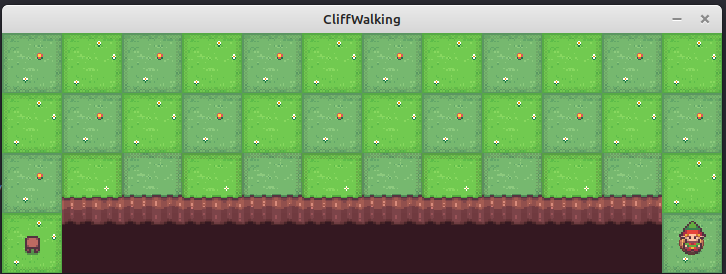
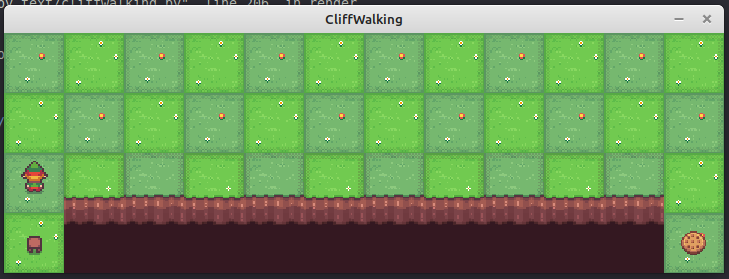
Figure 1:Playing CliffWorld step 1.
Figure 2:Playing CliffWorld step 2.
Figure 3:Playing CliffWorld step 3.
Figure 4:Playing CliffWorld step 9.
Figure 5:Playing CliffWorld step 12.
Figure 6:Playing CliffWorld step 13.